Wednesday, March 30, 2011

The visitors are back


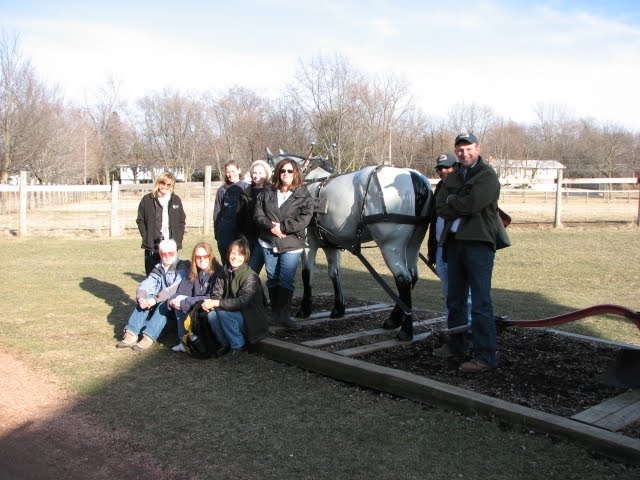
During the winter we get a little on the slow side when it comes to visitors. Now that the sun is out again and the grass is starting to green up we are having friends come back to see us. Today we crossed the 200 mark for the day. It is a start!

Monday, March 28, 2011

Update on the transplanter


Paul, Jeff and Andy are making quick work of the restoration of the transplanter. Jeff called the Holland Corporation and they sent us the correct paint scheme for the planter. Now we just have to hope we can remember how to put it back together again.

Saturday, March 26, 2011

Museum Conference


This weekend the Wagner crew attended the Midwest Museum Council meeting in Dayton, Ohio. I gave a session on the history of wheat and Jim and Evan presented on the development and uses of manure spreaders. Pretty exciting stuff right? You know you are a history geek when you say yes to that.

Other than learning about historical intricacies in agriculture, we got a behind-the-scenes tour of the United States Air Force Museum at Wright/Patterson Air Base. The museum was just massive. In fact, it was so big that by the time I got close to the back I was actually getting tired of walking. The museum is comprised of three huge hangers and each is jam packed with planes. To be there was to be in the presence of history. Strangely, it was not an airplane that most captivated me. In the WW 2 section there was a display of 80 silver goblets. Each cup was engraved with the name of a Doolittle Raider. In 1942 America had been beaten up pretty good by the Japanese. The country needed to make a statement that we were not going to just roll over. Col. Doolittle lead a squadron of B-25's off an aircraft carrier in the Pacific and bombed Tokyo. While the raid didn't do a lot of damage it did help morale at home. After the war, the Raiders got together each year to toast their leader, Col. Doolittle. At some point, a special set of goblets were made with each man's name on it. As different members passed away their goblet would be turned upside down. Today, there are only 6 of the Raiders left. Sometimes it is funny what grabs you and makes you think. Seeing those silver cups was really powerful.

Friday, March 25, 2011

Organic Pantry Project


Yesterday the Farm played host to an interesting little event. A number of local garden enthusiasts who are associated with the Organic Pantry Project had a seed swap. With the temperatures rising it is definitely time to start thinking about gardening.

Wednesday, March 23, 2011

Our friend Beth


If you have visited Wagner Farm you have likely met Farmer Beth. Beth first started out a volunteer and then moved to part-time weekends to lend us an extra hand. In 2006, she accepted the new Farmer position and has been a regular ever since. This past Sunday marked Beth's last day at Wagner. She is leaving the Farm to take a new position in the Glenview Park District. We wish her a lot of luck and best wishes. She is a real friend to us and many of our visitors.

Tuesday, March 22, 2011

Shop work


Paul and Andy have been busy working on one of the pieces of equipment that we are going to be taking with us on our outreach to the Smithsonian Institution in May. We have been asked to help interpret the role of a truck farmer. While I have never worked or even been around a commercial garden I think the job would be back breaking. Bending over to plant, hoe and then pick the crops all year long would leave you in a near permanent stupor. One of the machines that would have made this job a little easier would be a transplanter. This is what Paul and Andy are working to restore. This machine was either tractor or horse pulled through the field. Usually, two people would sit on the machine and feed seedling stock into a wheel that would automatically plant, mound and pack the dirt and then water the new seedling. This was especially helpful in the planting of crops like tomatoes and peppers. The transplanter that we have is from the middle twentieth century and made by the Holland Company. As our restoration progresses I will add some new pictures.

The top picture is of a Massey transplanter that is in someone's private collection.

Monday, March 21, 2011

Anything for her baby


Here's one last shot from our staff trip. When we were leaving the lamb barn we noticed off to the side a new baby lamb checking out the view with her mothers help.

Saturday, March 19, 2011

pigs

Here is another clip from our trip to Volkening Farm. On the coldest day this winter Evan's mama sow decided it was time to drop her litter. They all came out healthy and as you can see full of energy.

Thursday, March 17, 2011

Volkening's wooden windmill

Not many people have seen a wooden windmill. In the late 1800's that was the most common type used on farms. Because the wood was not the sturdiest of materials the engineers had to figure out a way to protect the windmill from going too fast and tearing itself apart. They came up with a system that as the speed of the fan increased the blades would actually turn in and make a tube shape. This meant the the full force of the wind would be diverted. Volkening has one of these early wooden mills. The video clip is really short but it shows how the blades can "furl" and change the shape of the fan.

Wednesday, March 16, 2011

tail wagging

When we went to Kline Creek we got to see a day-old lamb.

Tuesday, March 15, 2011

Our new big shovel and so much more


The Farm just took delivery of a brand new Bobcat loader. While this is far from something you would have seen on a 1920's farm it is a very common sight on a modern farm. A Bobcat is used for loading and lifting things from 800 pound hay bales to the loading the never ending supply of manure in to the spreader. This machine was partially funded by a generous gift from Mike and Julie Tracy. While they say "many hands make light work", a Bobcat makes it almost fun. Thanks

Monday, March 14, 2011

Staff field trip


This past week the Wagner crew went on their annual off site museum field trip. This year we went to Schaumburg to visit Volkening Heritage Farm and then west to Wheaton to tour Kline Creek Farm. The Chicago area has a number of historic farms that interpret many different time periods. A person could start at the 1840's at Garfield Farm go up in time 40 years to Volkening then another 10 to Kline Creek's 1890's site. The twentieth century is represented by Wagner Farm in the 1920's and Primrose which shows farm life in the Depression era.

For our staff, it was really neat to get to go behind the scenes and see how other site's deal with issues like storage, restoration and interpretation. I am going to try to post some videos I shot with the flip camera in the next week or so. Thanks to Evan, Monique and Jim for the great tours.

Thursday, March 10, 2011

wheat update


A little over a month ago I started growing some wheat for a presentation I'm going to give at a museum conference next weekend. I had hoped that the plants would at least be sending some stalks up but it looks like they are not going to make it in time for the speech.
We have also started some flats of pepper plants that we will take with us to Washington when we do the outreach program at the Smithsonian in May. We are going to set up a transplanter machine as part of our demonstration on Midwestern truck farming.

Monday, March 7, 2011

Silos on the brain


With this post I assume the risk of overbloggin about silos and silage. My apologies. The trouble is, with all the research and work we are doing with the subject they, silos, seem to be haunting me. As an example, this past weekend I drove back home to see family. I am from a farming community not far from Omaha, Nebraska. As I headed out of Chicago I thought about a recent exhibit meeting where I made the point that silos are disappearing from the rural landscape. As my car headed West out of the city I consciously watched for the first silo. It appeared just off Eola Road in Naperville. Then all the sudden I saw another one in Aurora. By the time I passed the Oberweis Dairy I was able to see multiple silos. In fact, this lead to a new game. I wanted to see how far I could make it before there were no silos in sight. Starting in Aurora, I made it basically to Omaha and only lost the sight of a silo twice. So much for my theory of the great disappearance of the mighty silo. As it ends up, I could not have been more wrong. In fact, at one point West of Dekalb I had 33 silos in my forward field of vision.
I learned something else very important on my trip. If you want to really embarrass your pre-teen daughter just start pulling off the road and ask random people if you can take a picture of their silo. I couldn't just drive by some of these really interesting silos and not take a picture. By the second stop Cassidy had assumed the stooped down position in the car and maintained it for the rest of the trip. Good times with Dad!

Friday, March 4, 2011

Strange story on Silage


With all this work we are doing on our new exhibit I thought I would share a couple things that I learned about silos. First, the word comes from the Latin word silus meaning cellar. Now this is interesting because the first silos were actually holes in the ground used to store grain. Even the Native Americans use "corn cellars". When the idea of ensilage preservation was beginning they stored it in the ground in what they were calling trench silos. The first one being documented in Germany in 1861. The story goes that Mr. Reihlen "found that much of his corn crop had been damaged by frost. Wishing to preserve it, he dug a trench in which he stored his maize; when he opened it a few months later he found the corn well preserved and discovered this cattle would eat it readily." In 1873 Fred Hatch of McHenry County, Illinois built the first upright silo. From there the silo boom grew. Early wooden silos gave way to brick and later glazed tile. These were soon dwarfed by the monster concrete and steel silos we commonly think of standing close by the old farm barn. Then something really strange happened. With all of man's desire to have the newest technology, silos went back to where it all started, the ground. Today most of the corn silage in the U.S. is actually stored on the ground or in flat concrete walled "bunker silos". After all that, it ends up that the first design was not only the best, but also the cheapest. That is irony!
The pictures are from the bunker silo up at Golden Oaks Farm. Thanks guys.

Wednesday, March 2, 2011

The invitation


This week Wagner Farm received a very special invitation. We have been asked by the Smithsonian Gardens to participate in their Garden Fest event in May. This year's theme is the "American Garden Experience". To help showcase the event, the Smithsonian invites outside organizations to participate. According to the Smithsonian, "Not all gardens are ornamental or hobby related. Many gardens actually are commercial in nature and we would like to include this as part of the experience." Because Wagner Farm interprets truck farming, or as it is also known, market gardening we are a perfect fit. The plan right now is to treat this as a very big outreach program. We will load up the truck and trailer with artifacts and other demonstrations items. If the weather is good, we were told to expect around 10,000 visitors that weekend. We are so excited for this opportunity!