Thursday, March 29, 2012

An Orange Maze

Posted by Lindsay


It was an interesting sight walking onto the Farm yesterday since the construction crew working on the grading project set up large orange fences in the center of the property. It looks as though a bright orange maze was constructed overnight. Luckily all features of the farm are still accessible and progress on the grading project continues!

Wednesday, March 28, 2012

Tractor Restoration Progress

Posted by Allyson

The past few weeks, Wager Farm volunteers Paul and Scott have been hard at work finishing up the restoration of the farm's 1955 Massey-Harris 33 tractor. With the weather turning warmer, Paul and Scott have been putting the finishing touches on the tractor so that they can start focusing on the fields and garden outside when April and May arrive. They've been spending the majority of their time and effort on the restoration of the tractor's metal work and paint since all of the mechanical parts are now in working order. When I stopped down in the basement last week, they were cleaning the front and rear wheels and giving them a fresh coat of harvest gold paint.

As you can see, it's coming together really nicely. Still in the works are a new battery, headlights, and decals and the addition of some safety triangles in case the tractor is every taken on the road. For now, plans are to use it for hay rides at special events and maybe even take it out on the weekends for families to enjoy.

Sunday, March 25, 2012

Flat ground, wet seed

posted by Todd


Progress continues with the event area grading project. A couple hours after this shot the crew got the grass seed in the ground and then the heavens opened up and we got almost an inch of rain. I hope the seed didn't end up in the ditch headed for Chicago. That's life on the farm!

Saturday, March 24, 2012

Teaching oink on the southside

posted by Todd

This week I was asked to lead a couple session on the topic of pigs for Cook County Ag Day. One of the reasons I have so much fun with my job is because I still get the chance to teach. The kids who were mostly 4th and 5th graders didn't have much background in farming but that didn't lessen their interest or enthusiasm.

Friday, March 23, 2012

Rained Out!

Posted by Sarah

My initial goal for this post was to write about one of our more popular scout programs, The Poultry Business. However, as you can see from the photos, the class took a rather wet turn. After weeks of very dry weather the skies opened up, just as we started one of our first spring fieldtrips. The boys had a great time collecting eggs, and splashing in puddles!


Thursday, March 22, 2012

Illinois PTA Convention

Posted by Sarah


I recently had the opportunity to exhibit at the Annual Illinois PTA Convention. Every year members of PTA's from all over the state gather to attend workshops, seminars, and learn about the wonderful opportunities for fundraising, fieldtrips, and other school-related activities. I spoke with parents, teachers, administrators, and life-long PTA members about the many fieldtrip options Wagner Farm has to offer. Most were surprised to learn that a dairy farm still exists in Cook County. I met a lot of great people and everyone was excited to tell their fellow teachers and principals about Wagner Farm.


Tuesday, March 20, 2012

Silo exhibit moving along

posted by Todd


I wanted to give a glimpse at the progress SVI Studios is making on the silo exhibit. A lot of the work has been centered on getting the plans developed for the structure and how it will go together once back at the Farm. They are also developing the color scheme that will be used through out the exhibit. The original silo wood that make up the walls has been cleaned and it is ready to be fit into panels that will be attached to the internal steel skeleton once it goes vertical. At the same time this is going on at SVI our Wagner Farm team is working on writing copy and picking out the images that will used on exhibit panels. Our in-house carpentry team has placed the steel and wood order and getting final engineer stamps on the stairs and platforms plans. As of today, the targeted completion date is June 1.

Monday, March 19, 2012

Lilly has returned

posted by Jeff

With school programs starting this week we went to Golden Oaks and retrieved our favorite lady, Lilly. We are back to being a dairy!

Once in the blue moon...

posted by Andres


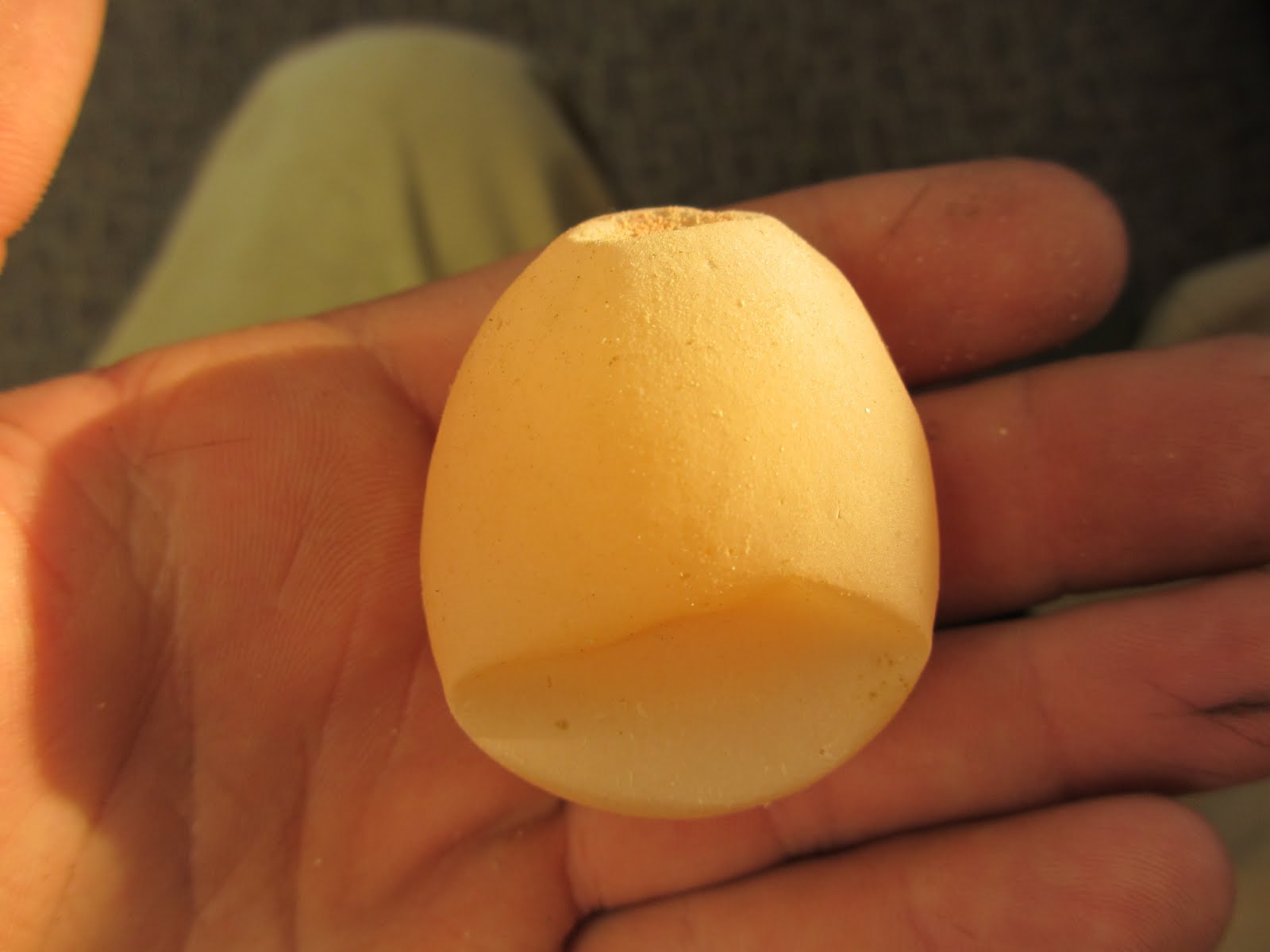
So, here on Wagner Farm we have a flock of Columbian Wyandotte chickens (for more info refer to Todd’s blog about the “new chickens at Wagner”). Now that the days are getting longer, the chickens are starting to lay more eggs. With that comes variation in the eggs, we are talking color, size, shape, everything. The really different ones I usually show to the staff, which normally warrants an “it’s sooo cute” from Lindsay. Farmer Jeff however, usually comes up with “just wait until you get one with no shell”. Now, its not that I didn’t believe him, but the only shell less egg I’ve seen is one that Patrick the intern soaked in Coca Cola. Then today, it happened. I walk into the coop this morning to feed and right there, on the ground (not in a nesting box) was an egg that looked like a flat tire. The rare shell less egg. I picked it up and started playing with it, and it was completely different from the one that was soaked, that one felt more rubbery, this one was deflated. I thought it was pretty cool none the less.
But wait, there is more. I looked on the inter web asking why this happens and found that there are a few different reasons this could happen. In older birds it is common in hybrid species that are placed in high production situations when they are coming out of laying season. In younger birds, if an egg stays in the shell gland too long, that egg gets over calcified (harder shell) and the next one gets under calcified. Both of these eggs are usually layed within the same 24 hour period. The final reason I saw had to do with a combination of hot days and low food intake. Even though today was pretty warm on the farm, I’m going to venture guess that reason number 2 is why I got to see this not so rare, but not so common shell less egg.

Saturday, March 17, 2012

Joyce's collection


In the front display cabinet of the heritage center we feature the collections of our staff and volunteers. The last two showings have featured the model tractor collections of Mary Beth and Jim. This week Joyce brought in her collections of horses. I met Joyce years ago when I was working as the director at the Museums at Prophetstown. Joyce is one of those people who has done everything. I like to hear her stories of driving horse carriages in downtown Chicago. I can't imagine having to compete for the road with all the buses, taxis and fast moving cars. If you have a chance, stop by and see the hundreds of horses in Joyce's stable.

Friday, March 16, 2012

Big and loud

posted by Todd


I stepped out of my office this morning to this strange sight. Usually it is the animals that get all of the attention but today the construction guys were the ones having their picture taken. With the great weather we have had big crowds this week and a lot of dirt work going on. The plan is to have the new elevations cut and the top soil back in place by the middle part of next week. I have my fingers crossed that we can get it all in before the next rain comes over.

Wednesday, March 14, 2012

You learn something new everyday

posted by AndresSo, I’m farmer Andres, and this is my first blog. Todd has asked me to contribute to the Wagner Feed this year and to be perfectly honest I’ve been thinking about what to write about for the last two weeks or so. Well, let me clarify, I’ve been trying to figure out how to start my first blog, because I know what I want to talk about but have never written a blog before (and this is how I figured I’d start). I have only been a farmer for a short while, and am loving every minute of it, as well as learning new things every day. Today I would like to share with you all something that I learned the other day and after I learned this fact I shared it with pretty much everyone I know, needless to say some of my friends got a little fed up with it. I heard a lot of; “dude, you told me about this yesterday”. Mind you this happens a lot, seeing as I learn something new about farming almost every day and love to share knowledge.
So, did you know that most cows have magnets in their stomachs? It came as a surprise to me as well. This information was brought to light a few weeks back when Daisy, one of our heifers, turned 1 year old and Farmer Jeff informed me that for her birthday instead of cake she was getting a magnet. Confused by this, I asked him to clarify, and out of his pocket he pulled a rod about 2.5 inches long ¾ inch in diameter and it was magnetic. This magnet is given to a cow around that age and remains in the first compartment of their stomach for the rest of their life. You may be asking yourself, “why does a cow need a magnet in their stomach? The answer is a thing called Hardware Disease, which basically means the ingestion of foreign materials, and it is considered a disease because it is contagious. Using the definition of contagious loosely, our vet told me that it is considered contagious because the foreign objects can be present in the hay which is eaten by multiple cows. (I know, it’s a stretch but that’s what the vet said.) The magnet itself is administered to the cow orally with a balling gun. A balling gun, for those who don’t know, is like a long stainless steel syringe type thing in which you insert the magnet, or pill, to be delivered orally, then you stick it down their throat a little ways hit the plunger and it drops into their stomach. The magnet stays there due to its weight and its job is to catch any piece of metal that the cow swallows and basically fixes it in their first stomach so that it cannot be regurgitated with the cud. If the cow was able to regurgitate it then the foreign object has more chances to tear up the esophageal tract and by fixing it in their first stomach it just sits and causes no harm. Mind you, a lot of the foreign objects cows consume now a days are not ferrous, but back when this practice was started plastics were not as prevalent on the farm. Either way, magnets are still administered to cows as a precautionary measure for Hardware Disease. So, the next time you walk by a cow and feel your keys being pulled from your pocket you will know why. (I’m just kidding, the magnets aren’t that strong.)

Tuesday, March 13, 2012

Pat Moon saves a life


A few days back I posted about our friend Pat Moon who is running the Iditarod in Alaska. Pat has had a tough run during the race and had to scratch out on Sunday when the seven dogs he was down to could go no further. Pat's story took a strange turn this morning as he was waiting in the town of Ruby and was called to something greater. A local child was riding his sled and crashed into a parked snow machine. Pat put his first aid skills to use and "stopped the bleeding and cleaned the cut, which helped keep the boy's face together" according to KTUU Channel 2.

Way to go Pat.

Interested horses

posted by Todd


Today when Ross and his crew were staking out the grading project it was fun to watch the reaction of the horses. Where ever Ross went they seemed to follow and show an interest in their project.

Monday, March 12, 2012

The Hayseed brothers reunite

posted by Todd


This past week I had the chance to travel to Madison, Indiana to take part in the Midwest Open-Air Museum conference. A conference for historians can take some interesting turns. While we have educational sessions, trade shows and networking there are also special classes offered relating to some historic aspect or trade. For this conference, I chose to learn the art of making a tin type photograph. In the 1850s this was the most common way of capturing an image. As part of the class, we prepared the tin by pouring on a liquid that was the consistency of syrup. Once this was "set", it was dipped in a silver solution for two minutes. Then the slide was ready to be placed in a frame that could be inserted into the box camera. The photographer, Robert, made some adjustments and took off the lens cover for about 15 seconds. In that amount of time the expose on the metal slide left an image of Evan (Evan is the historic farm manager at Volkening Heritage Farm) and I. One of the interesting things, in looking through the camera, we were upside down and backwards. If you have ever seen a Civil War image and the buckles or other writing seem to be backwards there is a reason for this. Once the exposure is taken then it goes through a series of chemical developers and washes. The whole process took about 20 minutes per image. It reminded me of a Polaroid as we watched the developer reveal the ghostly image. Here is one more example of how we are so spoiled to live in the 21st century!

Thursday, March 8, 2012

Volunteer Experiences

Posted by Allyson

One of the things that I value highly as the volunteer coordinator for Wagner Farm is seeing the satisfaction of the people who so generously donate their time and services to the farm. I think it is very important that we work with volunteers to create an experience that will fulfill both their needs and desires and the mission of Wagner Farm.

In January, I asked volunteers to submit testimonials about why they like volunteering here for us to include in some new volunteer materials. While I realize that this is not a method traditionally used to gather feedback, I found it to be very informative of what volunteers particularly enjoy about their experiences at the farm. Since Andy and Rob have just finished creating a special section on the bulletin board in the Heritage Center for volunteer information, I thought I would display a few:


I think Arlene and Patrick nailed it on the head, so to speak. There is something very appealing about being at a farm and having the opportunity to be a part of farm life.

If you feel the same way, consider stopping by our Volunteer Open House this Saturday from 10:00 am to 4:00 pm at the Wagner Farm Heritage Center to learn more about our volunteer opportunities at the farm and the Glenview Farmers Market.

Other things to see in Columbus, Wisconsin

posted by Todd


Besides stopping in to visit the Dunbar popcorn wagon we also did a little sightseeing in Columbus. Directly across the street from where the wagon was displayed was an architectural gem, a Louis Sullivan designed bank. In the courthouse, they honored their past by commissioning paintings done to show different periods in Columbus history. Their dedication to preserving the past earned the downtown area the special distinction of having three solid blocks on the historic register. When the movie Public Enemy about the life John Dillinger was looking for a historic back drop they chose Columbus since they didn't have to make major changes. I was even impressed they had a store that specialize in original period clothing.

Wednesday, March 7, 2012

Dunbar popcorn wagon

posted by Todd


One of the hardest parts of restoration is knowing what the artifact originally looked like. For our popcorn wagon there doesn't seem to be plans or many good examples out there to look at. I have been lucky enough to track down a couple of enthusiasts who have made Dunbar wagons their specialty. From these early conversations there seems to be less than 10 wagons in the entire country that are in excellent shape. One of the better examples happens to be in Columbus, Wisconsin which is about 3 hours north of Wagner Farm. I recently drove up to Columbus to see the wagon and document it. The Dunbar they have is actually owned by community members that chipped in to purchase the wagon and bring it back home to Columbus. Originally purchased by George Hasey in the 1920's the wagon was a Columbus fixture until Hasey's passing in the 1970's. The wagon was then bought and moved to California and later Las Vegas. All the while, the community kept tabs on the wagon's whereabouts. In the late 1990's the residents of Columbus raised enough money to bring the wagon home where it is now lovingly displayed. The wagon is a little bit newer than our model and it is shockingly completely. They even have the original receipt, all of the interior paint and the Dunbar nameplates. It seems the only incorrect alteration is the color of the carriage. It is supposed to be painted yellow, not red (the top picture is of Hasey selling popcorn in his yellow wagon in the late 1960's). Seeing it in person got me excited for our soon to start restoration plan.

Tuesday, March 6, 2012

The North Branch

posted by Todd

I got an email from Beth who used to be our farmer/jack of all trades. She is an avid reader, especially within the history field. She came across a book called, "The Lost Panoramas: When Chicago Changed Its River and the Land Beyond". Within the book was a picture from 1920's that had to have been taken very near Wagner Farm. The caption, "A team of horses help clear fallen trees and other debris in 1926 from the North Branch near Lake Street in Glenview, just west of what is today the Edens Expressway. Even the trickle of water from the far North Branch added to the flow toward the Mississippi." Beth and I have been trying to place the photograph but we aren't even sure if the shot is looking north or south. There does seem to be a road running parallel to the river on the left side. If anyone has a clue to where this picture was taken let us know. Great find Beth.

Monday, March 5, 2012

Iditarod

posted by Todd


A couple of years ago we had a very interesting guest speaker at our Wagner Farm volunteer meeting. Pat Moon from Park Ridge came and talked about what it is like to be a professional musher. Pat travels around the world competing in dog sled races. On the day he visited with us he brought his sled, the outer wear that protects him and his favorite dog Hera. Pat's presentation was one of the most interesting programs we had that year. I thought you might be interested in following him as they are running the 2012 Iditarod. It is actually fun to log onto the iditarod.com web site and keep up with Pat and his team as they cross each check point. Pat is bib number 15 and is currently in 59th place. Good luck to our own dog sled hero!

Sunday, March 4, 2012

Christine's roadtrip

posted by Christine


Last weekend I was lucky enough to drive down to southern Illinois to spend a couple of days with an experienced broom maker, Claudie Parsons. I got my introduction to broom making from Lindsay who took a workshop at a MOMCC (Midwest Open Air Museums Coordinating Council) conference. Since then, I've gotten most of my broom making information from websites, books, magazines, and YouTube. Of course, the downside is I don't have anybody to ask for advice on the various challenges of broom making.
There's only a handful of serious broom makers nationwide, and they all seem to know each other. Some make brooms because they are passionately committed to sustainable living. Some make brooms because they are history buffs. Others consider themselves artists and strive for highly ornate, decorative brooms. I think I'm a little of all three.
Claudie spent her youth in the Army, hanging telephone wire. When she got out of the Army, she came home and got a job as a roustabout. I swear, it's true. She was the first female roustabout her oil company ever hired. She learned how to make brooms from Richard Henson, a third generation broom maker from Kentucky who makes brooms for television shows and for Martha Stewart. Claudie sets up her broom shop at Civil War reenactments, and while she makes her fabulous brooms, her husband teaches [passing] kids how to make rope. In their spare time, they are a champion BBQ team.
My weekend with Claudie was extremely helpful. I learned how to use her kick winder, a foot powered version of our electric broom winder, how to wind brooms by hand without a winder, and a new way to stitch brooms that I'm very excited about. She also taught me one of the most exciting things about broom making: how to tie a broom onto the end of just about anything such as a spoon, hammer, table leg...even a deer antler! What's more, I took photos of all her equipment so that I can replicate pieces when I need to. It was fun to swap a few stories and commiserate about the hazards of broom making with a peer. I was delighted to find out that other broom makers also get little cuts all over their hands and sometimes wind their fingers into their brooms, too!